

First off, congratulations or I’m sorry. You have embarked on that grand adventure known as getting a job. This is no easy quest, my friend. It is like Pokémon—but instead of catching adorable creatures, you’re collecting disappointments from strangers in Human Resources. Your mission: to convince an employer that you are competent, charming, and somehow worth paying actual money to on a recurring basis.
Most young people think getting a job is easy. You walk in, smile, maybe shake hands, and boom—paychecks for life! Unfortunately, as most experienced people will tell you, that is only how it works in movies.
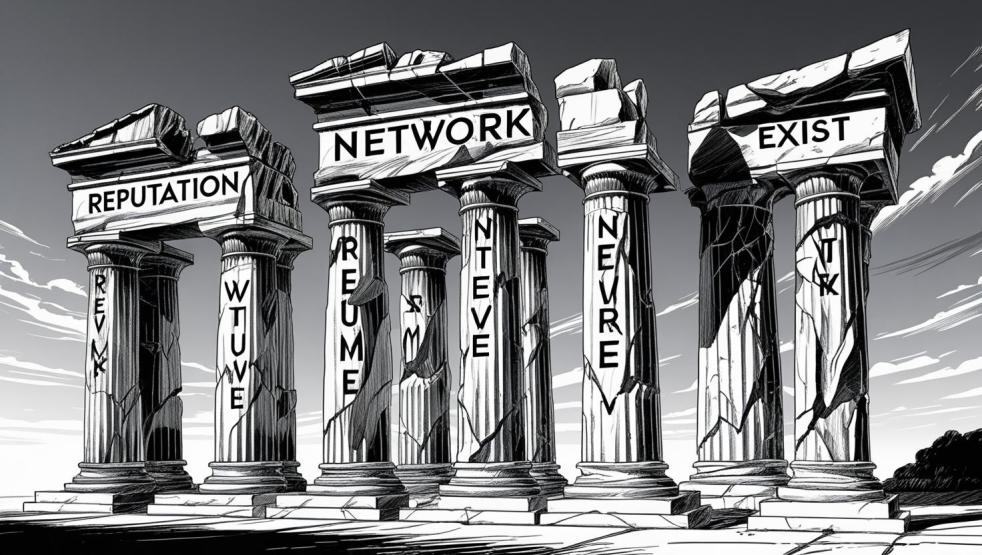
Real life hiring decisions are based on five ancient and powerful forces. We will explore them in sequence, because like Marvel movies, they all tie together into one giant interconnected universe. If you neglect even one of them, you could be consigned to the Employment Shadow Realm—AKA your parents’ basement, applying for four different jobs at 2 a.m. while eating leftover pizza.
1. Reputation (The Unshakable Foundation)
Before your résumé, before the interview, before your best “I’m totally normal in meetings” face, there’s your reputation—the Yelp review of you.
This is not just “Are you good at your job?” It’s the combination of:
- “Do people trust you to not break stuff?”
- “Do you consistently do what you say you’ll do?”
- “Will you eat other people’s yogurt from the work fridge?”
Your reputation is built over years, usually in small, invisible moments: completing projects without drama, helping coworkers without expecting applause and handling mistakes without blaming the intern. People remember how you made them feel and whether you accidentally set off the fire alarm during lunch.
Here’s the bad news: you can upgrade your Excel skills in a weekend, but repairing a rotten reputation takes time. If you’ve been “That Person” in the past, fix it before trying to move up or on. Think of it as credit repair—but instead of missed payments, it’s that time you “borrowed” the company projector for your cousin’s wedding slideshow.
Pillar Two: Network (Not Just LinkedIn Stalking)
There is a secret level to the job hunt that hardly anyone talks about openly—jobs are often not even posted publicly. They exist in a mystical plane known as The Hidden Job Market, which, coincidentally, is mostly just people texting other people. It is similar to “off market” real estate, a world where you can get the really cool houses before anyone else knows about them.
Networking is how you get to this off market emporium. Your network is not just “people you know.” It’s also “people who know people who tolerate you enough to suggest your name in a meeting.”
Networking does not mean just firing off random LinkedIn connections like “Hey, loved your article on cloud optimization strategy, wanna get coffee?” That’s low-effort. Real networking is like planting a garden—you nurture relationships during non-hiring seasons so they’re ready to bloom later.
- Bad networking move: Only calling someone when you need something.
- Good networking move: Sending congratulations when they get promoted, introducing them to someone who can help them, or at least sending a funny meme that made you think of them (and preferably not a politically charged or polarizing meme).
Your network is your hype squad. When your reputation is the foundation, your network is the scaffolding that gets you into rooms you wouldn’t otherwise enter—rooms with chairs made of leather, espresso machines, and recruiters silently Googling your name under the table.
Pillar Three: The Résumé (Your Paper Avatar)
Ah, the résumé—a single or perhaps multiple sheets of paper (or PDF) that will decide whether you get a phone call or a polite auto-rejection email saying they’ve “gone in a different direction.” Fun fact: that direction usually involves ignoring your existence.
Your résumé is your paper clone, sent into battle on your behalf. It must tell your story clearly, concisely, and without making the hiring manager’s eyes glaze over like a Krispy Kreme. Recruiters spend an average of about six seconds scanning each résumé, which is the same amount of time it takes to reject a bad dating profile. In other words: make those seconds count.
Key tips:
- Tell a story: Not “job description bullets.” Instead: “accomplishment bullets”, don’t be afraid to add some personality.
- “Led an underdog project from chaos to success while only crying twice.”
- Use action verbs: Say “Implemented,” “Designed,” or “Optimized.” Avoid “Was responsible for,” because that screams: “It wasn’t my idea, but they made me do it.”
- Customize for each role: Yes, you will want to copy-paste. No, you should not. Recruiters can smell résumé laziness.
Remember, a résumé isn’t your autobiography—it’s your movie trailer. Make them want to see the whole film (and not walk out halfway).
Pillar Four: Interview Skills (AKA Professional Flirting)
Let’s say your reputation is spotless, your network has done its job, and your résumé seduced the Applicant Tracking System into actually passing your name to a human. Now you face The Interview—a performance art piece where two or more humans pretend to be “casually” evaluating each other while secretly judging every shoe choice, word selection, and instance of weird blinking.
Interviewing is a skill, not a personality trait. You may be charming in a bar, but in an interview you must be charming while answering questions about “a time when you overcame challenges in a cross-functional team environment with changing priorities.”
Good interview skills involve:
- Preparation: Know things about the company besides “they pay money.”
- Storytelling: Answer with engaging anecdotes, not sterile lists. Make the interviewer visualize you as their future coworker who saves deadlines while bringing cupcakes.
- Active listening: This means not just waiting for your turn to talk, but adapting your answers based on what they said. Also, nod appropriately—enough to show engagement, but not like a bobblehead on caffeine.
The hardest part? Maintaining energy and optimism through multiple rounds—the corporate equivalent of an Olympic decathlon where gold medalists get… a desk with slightly better lumbar support.
And one important tip: yes, you are allowed to also evaluate them. Remember—interviewing is two-way. If their idea of “company culture” is “we have a ping pong table, but we also email you at midnight every night,” maybe you politely decline.
Pillar Five: And, Of Course, There Actually Has to Be a Job Available
We’ve built the reputation, nurtured the network, perfected the résumé, nailed the interview—and yet, sometimes there is a small problem: there is no job. This is the factor most job hunt guides skip because it is extremely uncomfortable to admit.
No amount of charm, skill, or networking magic can conjure a job that does not exist. You can be the ideal candidate for a role that exists only in the parallel universe where Blockbuster adapted successfully to streaming.
This is why timing matters. Economic downturns, budget freezes, or a variety of factors out of your control can take you down.
The lesson? Keep fishing in multiple ponds. Apply to several places, because hiring processes are chaotic, and sometimes your only “flaw” was bad timing. Think of it like dating: you could be Prince or Princess Perfect, but if they’re “not ready to get married,” you’re out of luck.
When All Five Pillars Align (The Employment Grand Slam)
When reputation, network, résumé, interview skills, and actual opportunity align, you get the mystical experience known as “A Job Offer.” This is basically a combination of winning the lottery and being chosen for jury duty—but in a good way, because this jury pays you.
If even one pillar falters, the employment structure gets wobbly. Great résumé but poor reputation? You’ll get interviews but no offers. Great interview but no network? You might never get in the room in the first place. Perfect everything but no actual jobs? So, allow yourself some grace and peace knowing that many things have to go right for you to get the job.
While much of this you must do on your own, if you need help with the resume or the interview, let me know because that is my specialty.
Final Thoughts
Getting a job is not just a matter of ticking boxes on an application form—it’s the delicate art of combining who you are, who you know, what you can prove on paper, how well you perform under mild interrogation, and whether all factors have aligned enough for there to be an opening at all.
It’s a process that blends strategy, luck, and timing. And yes, sometimes, it’s absurd—like being rejected for “lack of experience” for an “entry-level role” that somehow required five years of experience, a master’s degree, and your own forklift.
But when it works—when those five pillars snap into place—it’s incredibly satisfying. You walk into that first day knowing you navigated the maze, outwitted the algorithm, and impressed the humans. And now, it’s your job to build a brand new pillar: keeping the job.
Because remember—reputation starts all over again on day one. So maybe… stay away from the office fridge yogurts. For now.

 howtogetthejob.blog